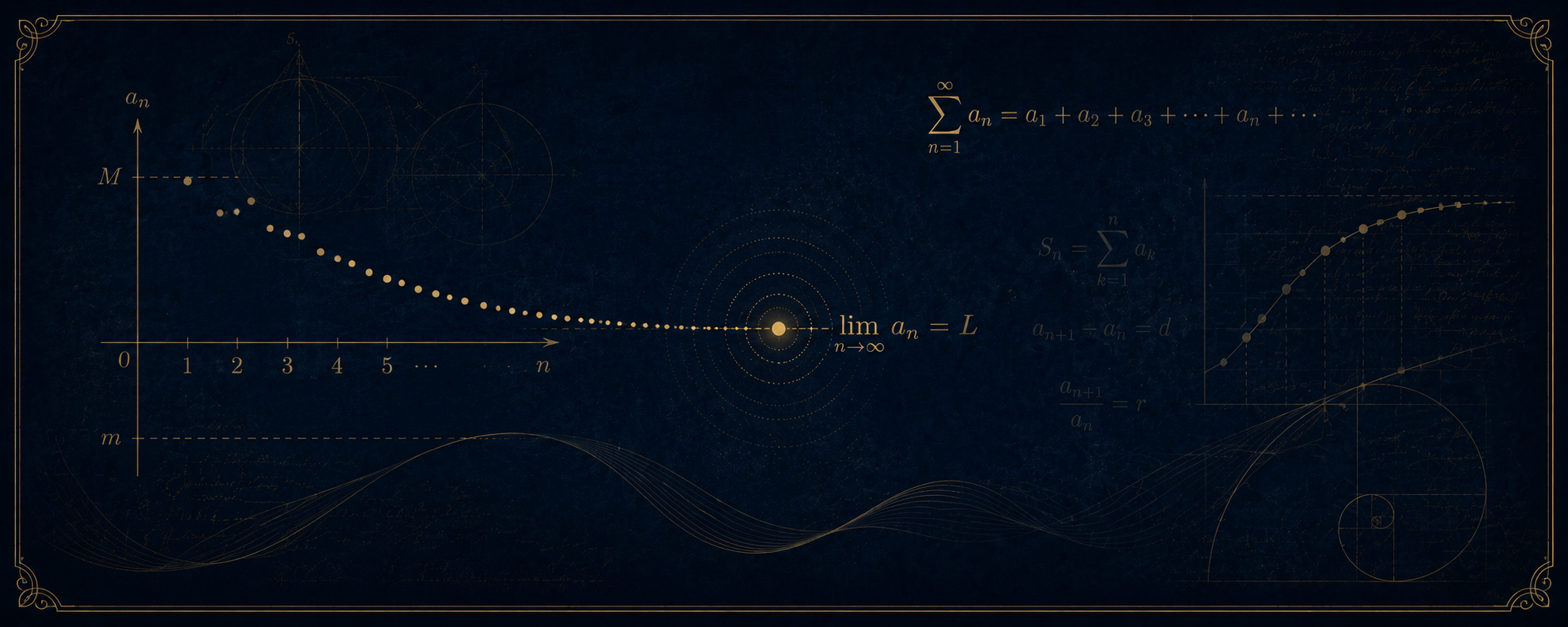
In this part, we explain the definition of sequences, arithmetic and geometric sequence structures, and the properties of monotonicity, boundedness, convergence and limits.
Ali Osman Uzun•June 4, 2026•18 min read
What Is a Sequence?
In mathematics, sequences have found a place in modern mathematical analysis as systems in which functions are ordered according to a particular rule. Sequences are viewed as structures in which functions are arranged in a definite order. Many examples appeared in antiquity, such as the sequence found in the Rhind Papyrus among questions concerning division in arithmetic. The ancient Babylonians regarded sequences as geometric progressions used in agriculture and astronomy. The Greeks treated sequences and their sums—that is, series—as philosophical subjects. Zeno's paradoxes attempted to explain how a sequence formed by repeatedly halving a distance could yield a finite result even though the sequence contained infinitely many terms. Archimedes summed a geometric sequence while finding the area of a parabolic segment. As we can see, many civilizations throughout history used sequences both in agriculture and in exploring the heavens. In this article, however, we will approach the subject neither agriculturally nor astronomically, but entirely mathematically. Through numerous examples and proofs, you will come to understand what sequences are and what they are not.
Definition of Sequences
Definition
Any function whose domain is the positive integers (Z+) is called a sequence.
f(1)=a1,f(2)=a2,…,f(n)=an
Here, the number an corresponding to the natural number n is called the general term of the sequence.
Example an=n1+n31
denotes the sequence whose terms include
a1=2,a2=85
Example
Find the fourth term of the sequence ((n+1)2n6)
Solution a4=(4+1)246=2524=a4
is obtained.
Types of Sequences and Their General Forms
Definition
If there exists a d∈R such that an+1−an=d
then (an) is called an arithmetic sequence, and d is called the common difference.
Example
Show that an=6n+11
is an arithmetic sequence.
Solution an=6n+11
an+1=6(n+1)+11
and
an+1−an=6∈R
so (an) is an arithmetic sequence.
Now let us find the sum of the first n terms of the arithmetic sequence
Definition
If there exists an r∈R such that anan+1=r
then (an) is a geometric sequence.
Example
Show that an=3⋅2n
is a geometric sequence.
Solution an=3⋅2n
an+1=3⋅2n+1=6⋅2n
Therefore,
anan+1=3⋅2n3⋅2n+1=2
so (an) is a geometric sequence, with common ratio
r=2
Now let us find the sum of the first n terms of a geometric sequence.
If
an+1=ran
then
a2=ra1a3=ra2=r2a1a4=ra3=r3a1⋮an=rn−1a1
Thus,
Sn=a1+a2+a3+⋯+anSn=a1+a1r+a1r2+⋯+a1rn−1
Hence,
Sn=a1(1+r+r2+⋯+rn−1)
Let
Sn=a1(1+r+r2+⋯+rn−1)
Then
rSn=a1r+a1r2+⋯+a1rn
Subtracting one side from the other gives
(1−r)Sn=a1−a1rn
Therefore,
Sn=1−ra1(1−rn)
Monotonicity
Definition an<an+1⟺(an)artan
an>an+1⟺(an)azalan
an≤an+1⟺(an)azalmayan
an≥an+1⟺(an)artmayan
Increasing or decreasing sequences are called monotone sequences.
Example
Examine the monotonicity of the sequence ((n+1)!2n)
Solution anan+1=(n+2)!2n+1⋅2n(n+1)!=n+22
Since
n+2>2
we have
n+22<1
and therefore
anan+1<1
It follows that
an+1<an
Thus (an) is decreasing.
Definition of Boundedness for Sequences
Definition
If there exists an M∈R such that, for every n∈N,
an≤M
then the sequence an is said to be bounded above.
Similarly, if there exists an m∈R such that
an≥m
then the sequence is bounded below.
Example
Examine whether the sequence ((−1)nn+1n)
is bounded.
Solution −1<−n+1n≤(−1)nn+1n≤n+1n<1
Hence the sequence is bounded both below and above; that is, it is bounded.
Convergence of Sequences
If, apart from finitely many terms, all terms of a sequence (an) lie in every neighborhood of a number a, then the sequence is said to converge to a, or a is called the limit of (an).
liman=a
or
(an)→a
A sequence is either convergent or divergent.
If, for every ε>0, there exists a suitable natural number N such that for all n≥N,
∣an−L∣<ε
then
liman=L
Example
Show that the sequence an=n1
converges to 0.
Solution
Let L=0
The inequality
∣an−L∣<ε
becomes
n1−0<ε
Thus,
n1<ε
is required. This means
n>ε1
Therefore, if
N=[ε1]
is chosen, then for
n≥N
we have
n1<ε
Consequently,
(an)→0
Limits of Sequences and Their Properties
Let
liman=a,limbn=b,δ∈R
Then:
lim(an+bn)=a+b
lim(anbn)=ab
If bn=0,b=0, then
limbnan=ba
lim(δan)=δa
If liman=a, then
limna1+a2+a3+⋯+an=a
Proof
Suppose
lim(an+bn)=a+b
Set
an+bn=cn
If
limcn=a+b
then for every ε>0, there exists an N>0 such that whenever
n>N
we have
∣cn−(a+b)∣<ε
That is,
∣an+bn−a−b∣<ε
From this,
∣(an−a)+(bn−b)∣≤∣an−a∣+∣bn−b∣
Since an→a, for every ε1>0, there exists an N1 such that when
n>N1
we have
∣an−a∣<ε1
Similarly, because bn→b, for every ε2>0, there exists an N2 such that when
n>N2
we have
∣bn−b∣<ε2
Choosing
ε1=2ε,ε2=2ε
and taking
N=max(N1,N2)
completes the proof.
Suppose
(an)→a
We will show that
limna1+a2+a3+⋯+an=a
Proof
∣an−a∣<ε
can be ensured by choosing
n>N0
and a suitable ε>0.
Split the sum into two parts:
limna1+a2+⋯+aN0+limnaN0+1+aN0+2+⋯+an
The first part contains finitely many terms, so
limna1+a2+⋯+aN0=0
Therefore,
limnaN0+1+aN0+2+⋯+an=a
This portion contains approximately n−N0 terms.
Treating each term as approximately a, the sum is approximately
a(n−N0)
Thus,
na(n−N0)=a(1−nN0)
Since
n→∞lima(1−nN0)=a(1−0)=a
we obtain
n→∞limna1+a2+a3+⋯+an=a
The proofs of Theorems 2, 3, and 4 are left to the reader as exercises.
Conclusion
This article presented the history and properties of sequences, the general forms of geometric and arithmetic sequences, convergence, and increasing and decreasing behavior in an entirely formal manner, with formal proofs. I thought we would fit in much more, but let that be enough for this time. In the next article, I will discuss the convergence of geometric and arithmetic sequences at a much more abstract level. Take care.
References
Balcı, M. (2020). Genel Matematik 1. Palme Yayınları.
Apostol, T. M. Calculus, Vol. 1, 2nd ed., Wiley, 1967.