
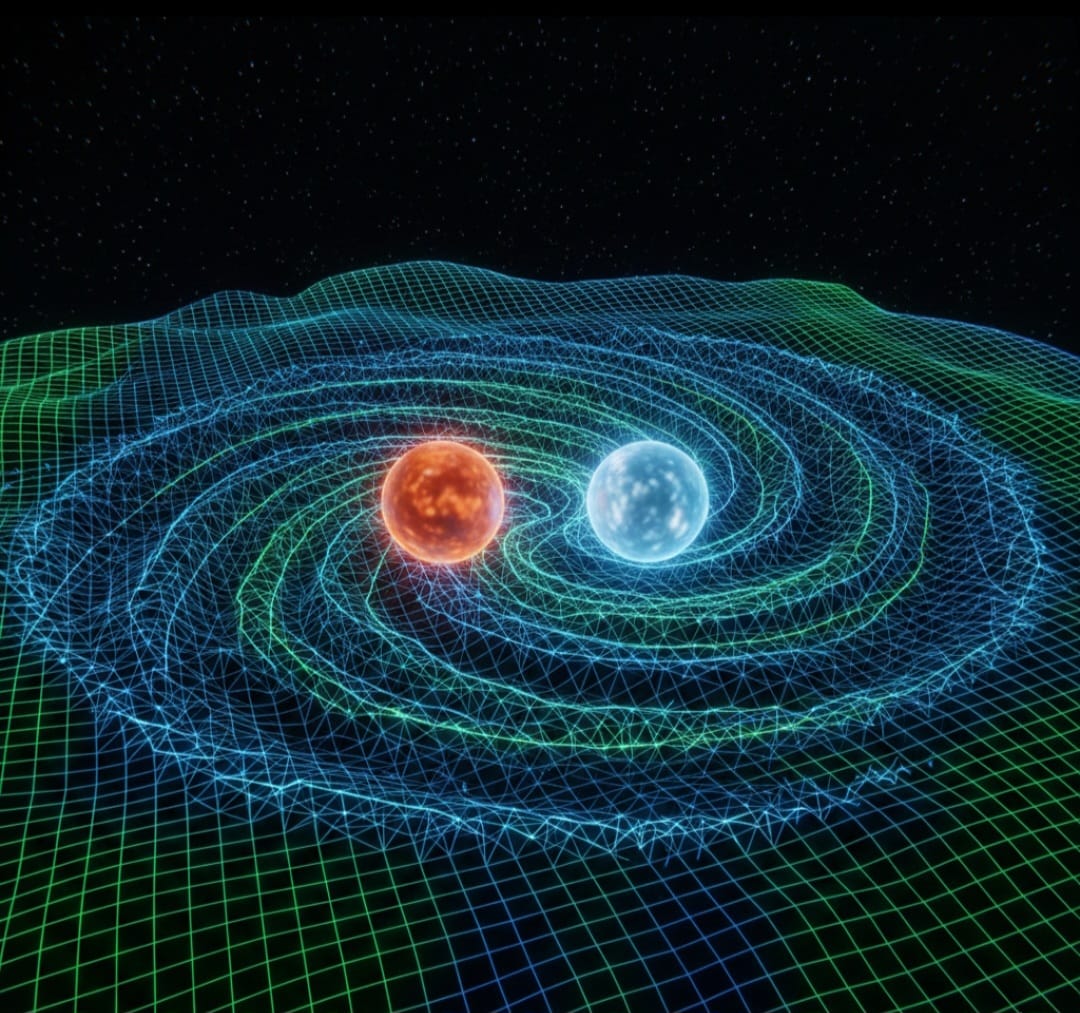
Einstein's magnificent theory: Relativity.
If there is an equation as widely known as Newton's famous equation , it must surely be . This formula first appeared in Einstein's paper "Zur Elektrodynamik bewegter Körper" (On the Electrodynamics of Moving Bodies), published in 1905, the year known as his "miracle year" (annus mirabilis). Another reason 1905 is called "miraculous" is that Einstein won the 1921 Nobel Prize in Physics for the work in which he explained the photoelectric effect that same year.
The main purpose of this article is to contribute to the rather limited Turkish-language resources on the theory of relativity.
Before we begin, let us state the two fundamental postulates on which Einstein based his special theory of relativity:
- The laws of physics are the same in all inertial reference frames.
- The speed of light in vacuum is the same for all observers, regardless of the motion of the light source or the observer.
Throughout this article, we will use the terms "reference frame" and "coordinate system" interchangeably. Everyone has some idea of what a coordinate system and an observer are, but the concept of an inertial coordinate system requires a little more care. We define reference frames in which Newton's first law holds as inertial reference frames.
Lorentz Transformations
Let us consider two reference frames, and . Suppose that moves in the direction with velocity relative to . At , the points and of the two frames coincide.
Any event occurring in the frame must also be describable in the frame. In other words, the coordinates of an event at point are measured as in frame and as in frame . The principal aim of the Lorentz transformations is to establish the relationship between these two coordinate systems.

To find the transformation between them, we may assume in the most general case that the transformation is linear. The homogeneity of space and time also supports this linearity. Since the relative motion between the axes is only along the -axis,
must hold.
In general, we can write and . Since the relative motion is along the direction, however, the expressions for and must not depend on or . Therefore,
Because the two frames have mutually perpendicular axes and move linearly, we may assume that there is a linear transformation between them. In its most general form, this transformation is
At , we have and , so there are no constant terms (that is, ).
Moreover, according to both observers, the motion of point must satisfy
Using this in (1), we obtain
Now let us write equations (1) and (2) in matrix form and solve for and :
Writing this briefly as ,
The inverse matrix is
Therefore,
Hence,
Now consider the configuration obtained by reflecting the system across the -plane. In this case, the coordinates of point are in and in . By symmetry, the magnitudes of the distance and time that we measure must remain the same.
Let us return to equation (3). Under the transformation , equation (3) remains valid only if (and, equivalently, also changes sign).

In equation (4), let us replace by their negatives (time does not acquire a minus sign):
From this, we conclude that
- Changing the sign of also causes and to change sign.
From this point onward, we will make the following assumption: the passage from to must be symmetric with respect to the two frames (as in Galilean transformations). In other words, we must be able to obtain one transformation from the other by making the replacement .
Under the transformations and , we then have
Let us also write this in matrix form:
Rearranging gives
that is,
Let us equate equations (4) and (6):
From this, we obtain
and
According to Einstein's second postulate, the speed of light in vacuum is the same for all observers. Let us proceed by using this invariance. Suppose that a light ray is emitted from point . Since both observers measure the same speed of light,
Using (1)–(2) and (9),
Therefore,
Together with (3),
Substituting (10) into (8),
In their final form, the Lorentz transformations are
and the inverse Lorentz transformations are
In the next article in our series, we will discuss Lorentz contraction, time dilation, and velocity/acceleration transformations—let us see where this theory takes us.