
Differential Geometry Series, Chapter 6—Torsion and Curvature
Hello, everyone; I hope all is well. For personal reasons, I had to take a long break from this series. We can now continue at full speed, however. In the previous chapter, we defined the Frenet frame of a curve in Euclidean space. In this chapter, we will take a closer look at the notions of curvature and torsion that we used in defining that frame.
Why Is Called Curvature?
Let the curve have the arc-length parameter . What, then, does its curvature at the point represent? Starting from the definition, we will answer this question with a geometric argument. From the definition of curvature, we know that
This gives us the component, in the normal direction, of the derivative of the curve's tangent at . We already know that the derivative of a curve's tangent has a component only in the normal direction and none in any other direction. Thus actually gives us the magnitude of the derivative of the tangent. By magnitude, we mean the norm and direction of the vector in question. Since the derivative of the tangent is in fact the second derivative of the curve, we should notice that is closely related to the curve's second derivative—that is, to its convexity. Let us return to our knowledge of calculus. The convexity of a function tells us something about the appearance of its graph. The figure below shows what it means for a function to be convex or concave.
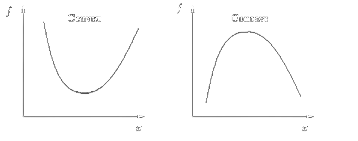
By the same reasoning, we can think of curvature as a generalization of this concept. Curvature, too, determines precisely how the graph of a curve will look. Study the following figure, and then let me continue.
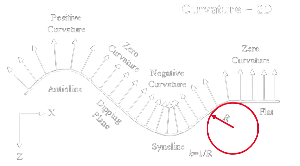
The image above shows, in a plane (“Hold on! Weren't we in three dimensions? Hadn't we grown up into big boys and girls? What are we doing back in feeble two-dimensional space?”), the forms a curve takes according to the sign of its curvature. There is plenty of detail in the image, but let me first make my point; afterward, I will answer your questions about “being two-dimensional” and “what that circle at the bottom right has to do with anything.” Let us begin where the curvature is positive: at those points, . (The curve has formed an upward hump.) Then, because the change in the change of the curve is zero—we are talking about the second derivative being zero—no humping occurs, and at those points . Next comes something like the hollow that forms when someone touches the back of your neck and your head moves forward. That is the negative-curvature part, where . Finally, the curve levels out again and its curvature becomes zero. In short, in two dimensions, an upward hump means positive curvature, a downward hump means negative curvature, and no hump means zero curvature. Now let us turn to your questions.
WHY ON EARTH ARE YOU EXPLAINING THIS IN TWO DIMENSIONS?
Here is why. Suppose, for example, that our curvature is positive. We now know what we will encounter in two dimensions, do we not? From there, reason your way to three dimensions. In three dimensions, you are in space and free: if you say, “A hump rises upward,” people will laugh at you—not for the hump analogy, but for saying “upward.” If we follow the logic that what is up for you is down for an Australian, we readily see that there is no direction called “up” in space. We may speak of up and down relative to the direction in which our curve progresses, and this can be described by a concept we have already defined: torsion. In short, whether the curvature of a curve in space is positive or negative is meaningless on its own. We cannot infer the graph of the curve from that alone, but things change if its torsion is known. Curvature and torsion tell us everything about a curve (that is the fundamental theorem of curves, is it not?). By asking this question early, you have made me introduce right here what I wanted to explain in the section on torsion. You have spoiled the whole secret.
What Is That Circle Doing in the Figure?
That circle is actually an imaginary circle (you don't say). In the image below, its radius is defined by , as a reciprocal of the curve at that point, so to speak. We imagine a circle with that radius tangent to the curve at the point. As the magnitude of the curvature increases, the circle becomes progressively smaller; conversely, it grows as the curvature decreases. When the curvature is zero, the circle is taken to have infinite size and is not drawn (how would you draw something infinitely large, right?).
In short, is called curvature because it helps determine where the curve bends. We will now talk a little about torsion and see what its geometric meaning is.
The Geometric Meaning of Torsion
To understand the geometric meaning of torsion, we must first define three different planes: the normal plane, the rectifying plane, and the osculating plane. Language purists, believe me, I have neither the energy to wrestle with you nor any idea how else to translate these names. These three planes are as effective as the Frenet frame in determining the character of a curve; indeed, they are derived from that frame. They are the planes perpendicular to the tangent, normal, and binormal vectors, respectively. Let us turn to the formal definitions.
Definition
Let the curve have the arc-length parameter . Then:
- The normal plane of the curve at a point is the plane perpendicular to the vector .
- The rectifying plane of the curve at a point is the plane perpendicular to the vector .
- The osculating plane of the curve at a point is the plane perpendicular to the vector .
To connect this definition with torsion, we will consider the osculating plane, because its normal is , and the derivative of gives us an equation involving torsion. In other words, the magnitude of the change in the normal to this plane is , since we know that
Thus torsion describes the change in the orientation of the osculating plane; it tells us which way the curve will “twist.” In this respect, it allows us to define in three dimensions something similar to what curvature does in two. This is why torsion is also called the “second curvature.” We know that zero curvature gives a curve that does not veer from side to side—in other words, a straight line. What does zero torsion mean? If torsion is zero, is a constant vector, which tells us that only and change in the Frenet frame. If only two vectors change, the curve lies not in space but in a plane. It is therefore a planar curve. Write that down and frame it:
Theorem
Let the curve have the arc-length parameter , and let its torsion be . Then the curve is planar.
After this interpretation and theorem, we can summarize as follows: geometrically, torsion tells us the direction in which a curve proceeds, while curvature tells us how it deviates from that direction. Knowing only one of the two does not allow us to reach a conclusion, but knowing both lets us draw the graph of the entire curve. They are two halves of the same apple.
In the next chapter, we will try to find the equation of a curve from only its curvature and torsion, without knowing the equation beforehand. After that, well, we will do some other things. Stay well.