
Euclidean Geometry
What's on the Menu?
Hello, everyone! I hope all is well. This chapter of our journey through differential geometry will be about a very special mathematician: Euclid. Although modern geometry now has almost no connection left with Euclid, he was the person who started it all. We will say a little about Euclid's Elements and his axioms, then touch on the debates surrounding his fifth postulate. After that, we will define Euclidean space.
Who Was Euclid?
Euclid was born in Alexandria in 330 BCE, at a time when Ancient Greece extended as far as Africa.
Although the land of his birth was one of the richest scientific centers of its time, geometry had not yet become a field with established formulas and theories by the time Euclid completed his education; it was used chiefly as a tool for solving everyday problems. In his thirteen-volume work titled Elements, Euclid reconstructed geometry from the ground up using twenty-three definitions and five axioms. The geometry constructed through the Elements was accepted throughout the world for centuries and named Euclidean geometry in his honor. The name might make Euclidean geometry sound like something known only to a particular circle, but in fact everyone who has graduated from high school has encountered it, because what is taught under the name of geometry in high school is none other than Euclidean geometry.
Euclid's Axioms
Definitions
Before Euclid's axioms, of course, we need to give the fundamental definitions he set out in the first volume. [1]
- A point is that which has no magnitude.
- The ends of a line are points.
- A surface is that which has length and breadth only.
- The boundaries of a surface are lines.
- A plane surface is a surface which lies evenly with the straight lines on itself.
- A line is breadthless length.
- A straight line is a line which lies evenly with the points on itself.
- An extremity of anything is called a boundary.
- A figure is that which is contained by any boundary or boundaries.
- A plane angle is the inclination to one another of two lines in a plane which meet one another and do not lie in a straight line.
- When the lines containing the angle are straight, the angle is called rectilinear.
- When a straight line standing on another straight line makes the adjacent angles equal to one another, each of the equal angles is called right, and the former straight line is called a perpendicular to that on which it stands.
- A circle is a plane figure contained by one line such that all straight lines falling upon it from one point among those lying within the figure are equal to one another.
- That point is called the center of the circle.
- A diameter of the circle is any straight line drawn through the center and terminated in both directions by the circumference of the circle; every such straight line also bisects the circle.
- An angle greater than a right angle is called obtuse.
- An angle less than a right angle is called acute.
- Of quadrilateral figures, a square is both equilateral and right-angled; an oblong is right-angled but not equilateral; a rhombus is equilateral but not right-angled; and a rhomboid has its opposite sides and angles equal but is neither equilateral nor right-angled. Let quadrilaterals other than these be called trapezia.
- Parallel straight lines are straight lines which lie in the same plane and, when produced indefinitely in both directions, do not meet one another in either direction.
- A semicircle is the figure contained by the diameter and the circumference cut off by it. The center of the semicircle is the same as that of the circle.
- Figures bounded by straight lines are called rectilinear figures: those bounded by three straight lines are triangles, those bounded by four are quadrilaterals, and those bounded by many are polygons.
- Of three-sided figures, an equilateral triangle has its three sides equal; an isosceles triangle has two sides alone equal; and a scalene triangle has its three sides unequal.
- Further, among three-sided figures, a right triangle has a right angle, an obtuse triangle has an obtuse angle, and an acute triangle has all three angles acute.
Axioms
Immediately after these definitions in the first volume of the Elements, Euclid listed the following five axioms. [2]
- One and only one straight line passes through any two points.
- A line segment can be extended indefinitely in both directions.
- A circle can be drawn given its center and a point on it (its radius).
- All right angles are equal to one another.
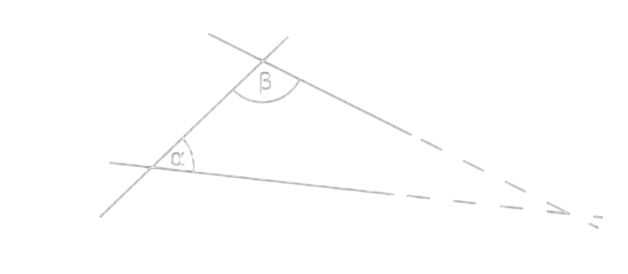
- If a straight line falling on two straight lines makes the interior angles on the same side less than two right angles, then the two straight lines, if produced indefinitely, meet on the side on which the angles are less than two right angles. (Through a point outside a given line, one and only one parallel line can be drawn.)
Although all the axioms appear clear and reasonable at first sight, the fifth puzzled some mathematicians because they thought it need not be stated separately and could instead be derived from the first four. Every attempt to derive what would later be called the Parallel Postulate from those first four axioms failed in turn. As a result, in modern geometry we know that the Parallel Postulate truly is an axiom—that is, it has no proof. Several axioms equivalent to the Parallel Postulate, which is rather difficult to grasp on a first reading, were proposed later; one of the best known is Playfair's Axiom.
Playfair's Axiom
In a plane, through a point not lying on a given straight line, at most one straight line can be drawn that never meets the given line.
I think we have had a sufficient dose of history by now. We visited the forefather of classical geometry and heard from him how he built it. Now it is time to combine all this with the groundwork from the previous chapter.
Three-Dimensional Euclidean Space
In this chapter, we will meet the quintessential Euclidean space. Three-dimensional Euclidean space is where it all began: classical differential geometry was first developed in this space by bringing together all the axioms and the other disciplines of mathematics. We will follow that chronology. In fact, we will rarely leave this space; even when we do, we will take care to remain in three dimensions.
Definition
Let the inner product be defined, for
,
by
This inner product is called the Euclidean inner product. The norm defined by this inner product is likewise called the Euclidean norm. [3]
Mathematics is inquisitive by nature (some call it a science, others a language—let us not get into that debate), so rather than taking our word for it, we suggest that you prove this really is an inner product. (Do us a favor and check whether it satisfies the inner-product properties given in Chapter 2.)
Definition
Let be the Euclidean inner product. Then the inner product space defined by
is called three-dimensional Euclidean space. [3]
The letter in the definition comes, of course, from the English spelling of Euclid. To summarize these two definitions, three-dimensional Euclidean space is in fact an inner product space. Its particular inner product is called the Euclidean inner product, which readers familiar with physics will know well by its other name: the dot product. This space is founded on the five axioms built within the framework of Euclid's definitions, with an inner product defined in addition. The inner product will be immensely useful because it will allow us to define concepts such as angle and length.
Definition
Let . The cross product of and (also called the vector product) is denoted by and defined by
Here, , , and . [3]
This definition, too, will be familiar to readers who have taken courses such as linear algebra or mechanics. Let us now discuss the angle between two vectors in Euclidean space.
Definition
Let be the Euclidean norm and let . The Euclidean angle between and is defined by
Definition
Let . When the Euclidean angle between the vectors and is radians, and are said to be perpendicular, denoted by .
Theorem
If , then
Proof
The proof is quite easy. Suppose that . Then the Euclidean angle between and is radians. Hence
and therefore . It follows that . Conversely, suppose that . It is immediately clear that
which completes the proof.
In the Next Chapter...
We have reached the end of another chapter. Here, we made a classical introduction to differential geometry. In the next chapter, curves—and several definitions we will make concerning them—await us. Take care!
References
[1] Tanımlar. (n.d.). A. S. Sertöz (Çeviri), Öklid’in Elemanları (8 Mayıs 2018 sürümü ed., pp. 1–2).
[2] Wikipedia (2005, Mart 17). Öklid geometrisi. Vikipedi. Mart 7, 2022 tarihinde alındı, https://tr.wikipedia.org/wiki/%C3%96klid_geometrisi#Aksiyomlar
[3] Manfredo, P. do Carmo, Differential Geometry of Curves and Surfaces, 1976.