
What Exactly Is This Series?
1. What Exactly Is This Series?
The differential geometry series is a Biricik Bilim project that aims to venture a little beyond the differential geometry courses taught in mathematics and physics departments. We present a series that begins with the history of differential geometry and whose eventual endpoint remains uncertain. Broadly speaking, we plan to discuss the history of differential geometry and the structures of two- and three-dimensional Euclidean spaces, then generalize the discussion to n-dimensional Euclidean space. Afterward, with an emphasis on three-dimensional Euclidean space, we want to explain what curves are in these spaces.
We will then discuss Frenet frames and their applications, cover special curves such as helices and Bertrand curve pairs, and carry the subject over to surfaces. What comes after that is genuinely uncertain: we may move on to Riemannian manifolds or to non-Euclidean spaces. The portion planned so far will generally run parallel to university differential geometry syllabi, though it will contain a little more detail. Without further ado, let us begin this adventure.
2. The History of Differential Geometry
As its name suggests, differential geometry is a branch of geometry. Its history therefore begins with the history of geometry.
Geometry is essentially a discipline whose foundations were laid roughly five thousand years ago in Mesopotamia and Ancient Egypt as people solved problems from daily life. These problems included calculating how much the Nile would flood, finding ways to divide a plot of land into equal parts, and measuring the volume of an object. As you can see, in a world where problems that now seem quite simple to us were genuine problems, geometry would have been far more rudimentary than the geometry we know; it would therefore not be entirely accurate to call it geometry in the full sense. In short, the work done at the time had little theoretical foundation. You know how we now ask, “What is the proof of this?” Back then, problems were simply solved, and whether the solution really was a solution was not questioned very much.
Even so, some intriguing work emerged. We would like to share an example from the history of geometry lectures given by our teacher Can Ozan Oğuz at Nesin Mathematics Village. ([1]) This example concerns a feature of one of the oldest known tablets related to geometry, the Babylonian tablet YBC 7289. You can see a photograph of the tablet below.
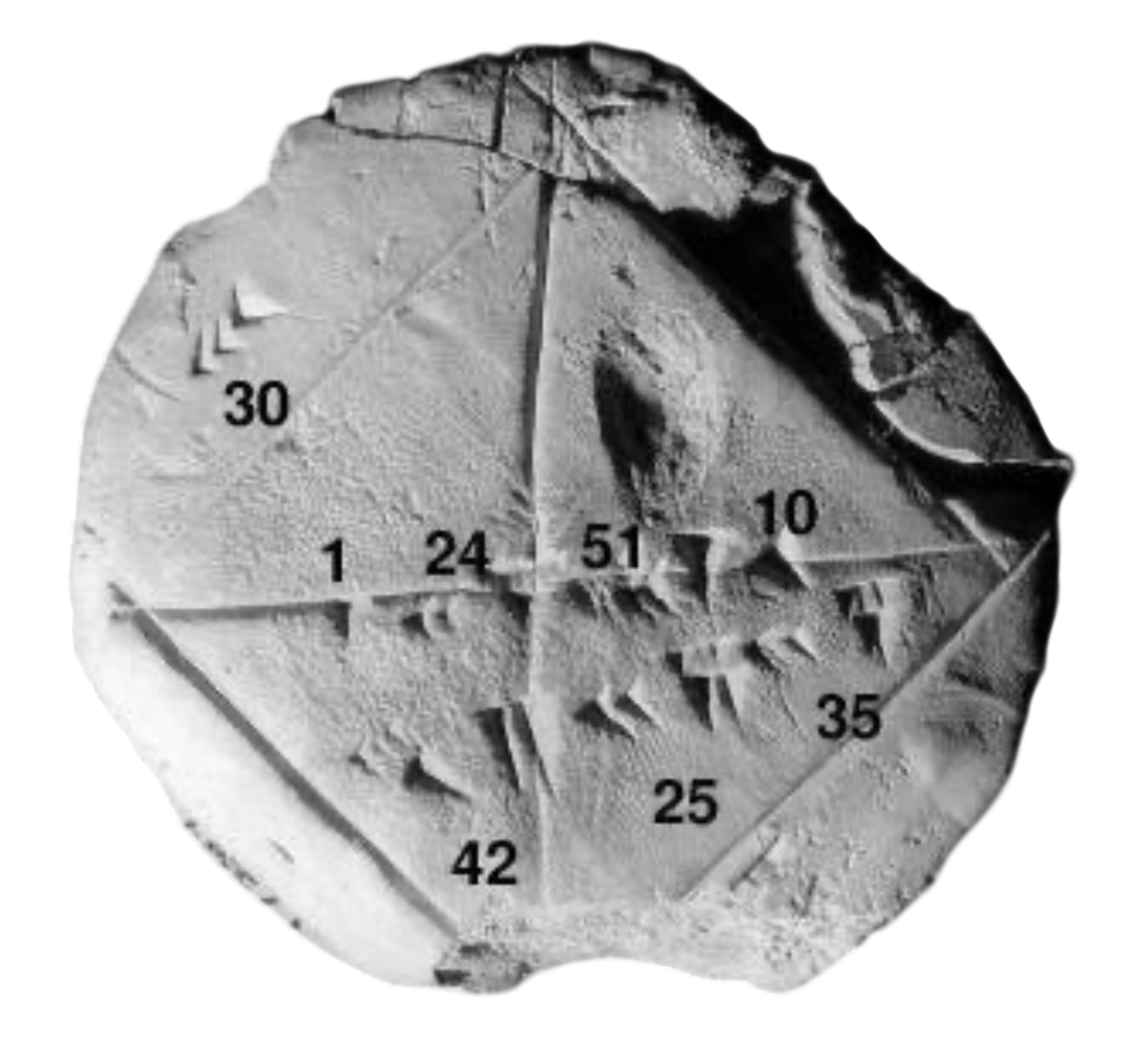
The tablet shows a square whose diagonal length has been calculated. In the Babylonian period, numbers were written in base 60 (a day has 24 hours, an hour 60 minutes, a circle 360 degrees—what a coincidence, right?), so the lengths are sexagesimal numbers. In this calculation, the diagonal of a square with side length 30 ( in base 10) was calculated as 42, 25, 35, while converting the number 1, 24, 51, 10 to base 10 gives us a remarkably good approximation of √2.
Historians believe that this tablet was used by a student sometime between 1800 and 1600 BCE—long before Pythagoras was born. It is quite exciting to encounter an application of the Pythagorean theorem on a Babylonian tablet when the theorem itself did not yet even exist. At least we know that this calculation was not based on a theory, though centuries later it became clear that, in essence, it rested on a very powerful one.
After Mesopotamia and Ancient Egypt, Ancient Greece took the stage. Since this was more of an age in which philosophers abounded, people began questioning things, and proving them consequently became a necessity. This marked the birth of geometry in the form most similar to what we know today. Both Euclid and Pythagoras lived in Ancient Greece. Pythagoras, with his fiercely loyal disciples and his theorem, and Euclid, with his thirteen-volume Elements, secured their places in the history and mathematics books.
The story of Pythagoras is somewhat curious: although it has never been proven, Pythagoras was a murderer. Since one thing has led to another, let us tell the tale. In his time, Pythagoras was treated almost like a spiritual leader. He had devoted followers and was much loved by the public. Pythagoras placed enormous importance on numbers, believing them to be the language of the universe and sacred. And when we say numbers, remember that this was Ancient Greece: there were no π's and the like; only rational numbers were known. At one point, Pythagoras reportedly wondered how the hypotenuse of an isosceles right triangle could be measured with a ruler or something similar. Numbers were sacred, after all, and he believed that everything could be expressed as a (rational) number. A student of his named Hippasus proved that the hypotenuse of an isosceles right triangle could not be expressed as a fraction, whereupon Pythagoras's disciples drowned Hippasus. We would love to give you that proof right now, but our editor is very fond of Pythagoras, so let us not muddy the waters.
Euclid, meanwhile, wrote the thirteen-volume Elements and laid virtually all the foundations of geometry. These books begin with sections containing Euclid's definitions and axioms, explaining how everything from a point to a circle is to be defined and setting out certain rules. Since we will return to these in later sections, let us leave the details aside for now.
Following these ancient periods, Muslim scientists on the Arabian Peninsula rose to prominence, while the feudal era began in Europe and science was left in Arab hands for several centuries. Geometry naturally had its share of these developments. Conscious of having inherited Euclid's legacy, Muslim scientists carried matters further: rather than solving everyday problems merely by drawing triangles and circles and dropping perpendiculars, they began producing solutions using angles, ratios, and algebraic identities. Trigonometry was born in this period. You have probably seen tables listing the values of trigonometric functions at different angles; those tables were first compiled during this era.
After several centuries of these developments, science once again crossed the salty waters of the Mediterranean and reached the European continent on the back of a movement springing from the Italian peninsula: the Renaissance. During this period, work became more artistic and visually satisfying, bringing a field called perspective geometry into geometry. The mathematicians René Descartes and Pierre de Fermat also helped lay the foundations of differential geometry by conceiving of doing geometry with coordinates. The work of Sir Isaac Newton (we have not forgotten Leibniz) likewise gave birth to a field called calculus, and geometers naturally drew on it. Differential geometry emerged precisely when the newly born perspective geometry and calculus intersected.
Through the contributions of the German genius Carl Friedrich Gauss, the French mathematician Jean Frédéric Frenet, Bernhard Riemann, and many other mathematicians, the concepts of derivative and integral began to be used in geometry. It thus became possible to construct the analytic equation of a curve, study properties such as its curvature and torsion, and make certain interpretations. Nor was this limited to curves: much could now be said about surfaces as well. Gauss made a great many contributions to the study of surfaces and was the intellectual father of the Gauss–Bonnet theorem, which unites topology and geometry.
Mathematicians, of course, were not going to be content with curves and surfaces alone. Bernhard Riemann generalized an idea of his doctoral adviser Gauss to n dimensions and introduced the concept of a manifold, breathing truly new life into geometry for the first time since Euclid. Euclidean space was flat; it had no curvature. Gauss, however, said that differential geometry could also be carried out on curved surfaces. Riemann made the decisive move by showing that this was not limited to surfaces. From then on, nothing would ever be the same.
Lorentz and Minkowski constructed a non-Euclidean space that bears their names. Usually called Minkowski space in the literature, though also known as Lorentz–Minkowski space, the only feature distinguishing it from Euclidean space is that the metric defined on it contains a minus sign; this gives rise to three different types of curves and surfaces. From here the doors to relativity open wide, and Einstein has the next word. Geometry on Einstein manifolds remains a popular research topic today.
But if you think the reign begun by Riemann continued unchallenged, you are mistaken. Hermann Weyl, a student of Hilbert and Minkowski, extended Riemannian manifolds further to construct Weyl manifolds, taking his place in the history of geometry as yet another German. Because this type of manifold caused difficulties when adapted to physics, however, it did not delight physicists and remained an interesting mathematical object. Contemporary research in geometry focuses on certain special types of manifolds.
References
[1] Oğuz, C. O. (2021). Geometri Tarihi 1 - Antik Dönemde Geometri [Slayt]. Google Docs.
https://docs.google.com/presentation/d/1BdHUlMHO9-CpGu7cLaEv3q1j9zWW61LQY-vmEo76aCg/edit#slide=id.gc5f48274d2_0_213